

Scrap Somalia’s E-Visa Now: Warnings Ignored, Identities Exposed
 By Warda
November 14, 2025
By Warda
November 14, 2025
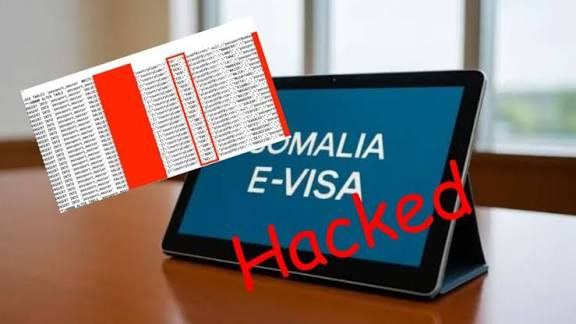
The case for digitizing borders is often made in the language of progress. A portal promises speed, a dashboard suggests control, a database implies modern statecraft. In a live threat environment, these are veneers. Somalia’s centralization of traveler identities, itineraries, and documents for diplomats, aid workers, businesspeople, and diaspora created an intelligence cache that adversaries could plausibly obtain. Security analysts warned publicly in early November that this model would convert pre-arrival vetting into a pre-packaged targeting file. The warnings were brushed aside. Days later, the breach arrived. On Nov. 11, 2025, regional outlets reported a full compromise of Somalia’s e-visa portal and its takedown, with roughly 35,000 traveler records exposed; Somaliland Chronicle (somalilandchronicle.com) detailed the leaked fields and volume, while the Horn Tribune confirmed the shutdown and scope. In border policy, centralization without capacity is not modernity, it is preemption by your adversary.
The warning that went unheeded
On Nov. 3, a public security analysis argued that Somalia’s e-visa was not modernization but a self-inflicted failure (Somaliland.com). The portal demanded full names, passport pages, high-resolution photos, flight numbers, arrival dates, local addresses, phone contacts, and sponsor identities. In a theater where kidnappings and assassinations occur, such aggregation was a standing invitation to exploitation. The proposed remedy was restraint, fragmentation, and independent audits. The policy remained in place, the portal stayed live, and the risk curve steepened.
From prediction to breach
Within days, prediction became fact. Coverage on Nov. 11 reported a mass exposure of Somalia’s e-visa system and its removal from public access. Somaliland Chronicle described the data release as a terrorist “kill list,” citing about 35,000 records with passport data, itineraries, contact details, some payment information, and even administrator credentials. The Horn Tribune reported the takedown and echoed the estimated scale. These are not routine privacy losses. They are the raw materials of targeting.
What was exposed, and why it matters
Public accounts indicate that records included biographic passport pages and photographs usable for positive identification, dates of birth and passport numbers, flight details and intended addresses, phone numbers, sponsor networks, and in some instances payment-related fields and back-end credentials. In Somalia’s conflict environment, that combination enables targeting before arrival, during transit, and at lodgings. It converts a bureaucracy into a map for coercion. The U.S. Department of State already rates Somalia “Level 4: Do Not Travel,” a reminder that any exposure of identities and itineraries multiplies physical risk for officials, NGO staff, and contractors.
A single point of failure in a war theater
Threat actors look for concentration points where one weakness yields disproportionate gain. Somalia’s e-visa consolidated sensitive data for all travelers in one civilian web system without the disciplines that protect high-value targets: independent penetration testing, strong authentication, credential vaulting, network segmentation, and tamper-evident logging. Open-source reporting describes flaws so basic that records could be enumerated through simple URL manipulation, a method consistent with mass scraping rather than a sophisticated intrusion. In fragile contexts, fragmentation is protective; centralization magnifies risk.
The human and diplomatic costs
The breach imposes immediate, non-abstract danger in Somalia. Exposed travellers now face elevated kidnap and assassination risk. Al-Shabab, a U.S.-designated Foreign Terrorist Organization and Specially Designated Global Terrorist, conducts kidnappings and mass-casualty attacks. Putting verified identities, itineraries, and local contacts into hostile hands simplifies target selection and route timing. Humanitarian agencies must adjust duty of care, rerun threat assessments, and vary itineraries. Businesses will withdraw staff rather than accept liability. Airlines that enforced pre-clearance tied to the compromised portal helped expose their passengers and will now answer insurers and regulators. Foreign ministries must brief at-risk nationals, rotate passports, and harden movement discipline for those who still travel. For perspective, replacing passports typically costs U.S. adults about 130 to 246 dollars depending on book type and options, with routine processing often 4 to 6 weeks or 2 to 3 weeks if expedited. U.K. online replacements cost 94.50 pounds with typical returns around 3 weeks, while one-week Fast Track runs 178 pounds. Emergency travel documents exist but are short-lived and restricted.
Ignored warnings, predictable outcomes
This breach did not surprise those who examined the model. Analysts warned that a centralized, poorly defended repository would become an adversary’s harvest. They noted the absence of credible cybersecurity capacity and the risk that insiders, corruption, or simple enumeration could yield mass exposure. The public record now shows the chain from warning to compromise to shut down. This is the textbook sequence of avoidable failure: advice issued, advice ignored, damage realized.
What responsible actors should do now
Governments. Notify affected nationals, offer expedited passport replacement, and invalidate exposed numbers in appropriate databases. Expand consular alerts. Withhold recognition of Somalia’s e-visa pending an independent forensic review against recognized baselines. Reference the standing “Do Not Travel” advisory so travellers understand the compounded risk.
International organizations and NGOs. Treat all portal submissions as compromised. Vary routes, upgrade local protective measures, and move sensitive coordination to secure channels. Require proof of independent audits before considering any future digital authorization linked to Somalia.
Airlines and aviation partners. Suspend any requirement to present Somalia’s e-visa for carriage. Accept alternative documentation consistent with aviation norms and coordinate interim procedures that keep pre-arrival data inside airline API and PNR pipelines rather than public web forms.
Exposed travellers. Replace passports where risk is non-trivial, reissue payment cards used for fees, register with your government’s advisory system, and vary travel patterns if movement is unavoidable. Retain documentation of out-of-pocket costs in case liability is established.
Accountability and standards
When states compel foreign nationals to submit advanced data, they assume obligations to protect it to international standards. Those obligations include least-data collection, encryption in transit and at rest, role-based access, audit logs, third-party testing, and strict segmentation between public web layers and back-end systems. By the reported facts, these disciplines were not visible. Donors and partners should condition any future support on demonstrated compliance verified by independent auditors. Cosmetic changes will not remedy a structural weakness.
Scrap the portal, do not salvage it
There will be calls to patch and relaunch Somalia’s e-visa. That course assumes away the core defect. A fragile environment with adaptive adversaries should not channel high-value personal data through a single civilian portal. Even a tightened building would centralize risk and tempt renewed compromise. The sound step is to terminate the system and revert to lower-exposure methods: visa on arrival with pre-arrival flows limited to secure airline industry channels that apply strict retention limits. Consider any future digitization only after independent certification shows the platform can resist the specific adversaries already watching.
The policy judgment
Somalia’s case shows states are measured by prudence, not optics. Here, convenience for administrators was elevated over safety for traveller’s. Warnings were issued. They were ignored. The result was the exposure of identities, movements, and networks to those who would do harm, including al-Shabab. Policymakers, carriers, and partners should press for a complete scrapping of the e-visa regime. Anything less invites repetition. The reporting record already shows the arc from early warning to mass exposure and shutdown. The prudent response is to end the experiment, protect security, and restore visas on arrival at major airports with minimal data collection, a model that builds trust and improves security